Teaching, research, and service are the three pillars of the faculty profession, and over the course of a career, one discovers that service quietly absorbs more time and shapes more outcomes than most new hires anticipate. Under AR 3:8, faculty workload is negotiated annually with the chair and dean as a percentage split across teaching, research, and service. Untenured assistant and associate professors should expect 5–10% of their effort allocated to service—deliberately kept low so they can establish a research program and teaching portfolio. After tenure, that allocation typically rises to 10–15%, and as a full professor, I carry 10–20% with a hard minimum of 10%. The university recognizes a fourth category—administration—for roles like department chair or associate dean, which come with course releases and are generally reserved for full professors.
What the percentages do not capture is that service is not one thing. I think of it as three concentric circles: service to the department, service to the college and university, and service to the profession and the broader community. Early in a career, most service lives at the department level—committee work, curriculum review, mentoring. As one becomes more established, the college and university pull faculty into larger roles—search committees, program reviews, governance. And throughout, the professional community expects its members to review papers, organize conferences, and contribute to the standards and practices that define the field. I have found that the most effective service reinforces research and teaching rather than competing with them. An editorial board appointment deepens knowledge of the literature. A curriculum committee role shapes the courses students take. An industry board seat connects research to real applications. The worst service is the kind that has no relationship to anything else one does.
What follows is an account of how I have tried to build a service record that serves all three circles, organized from the department outward.
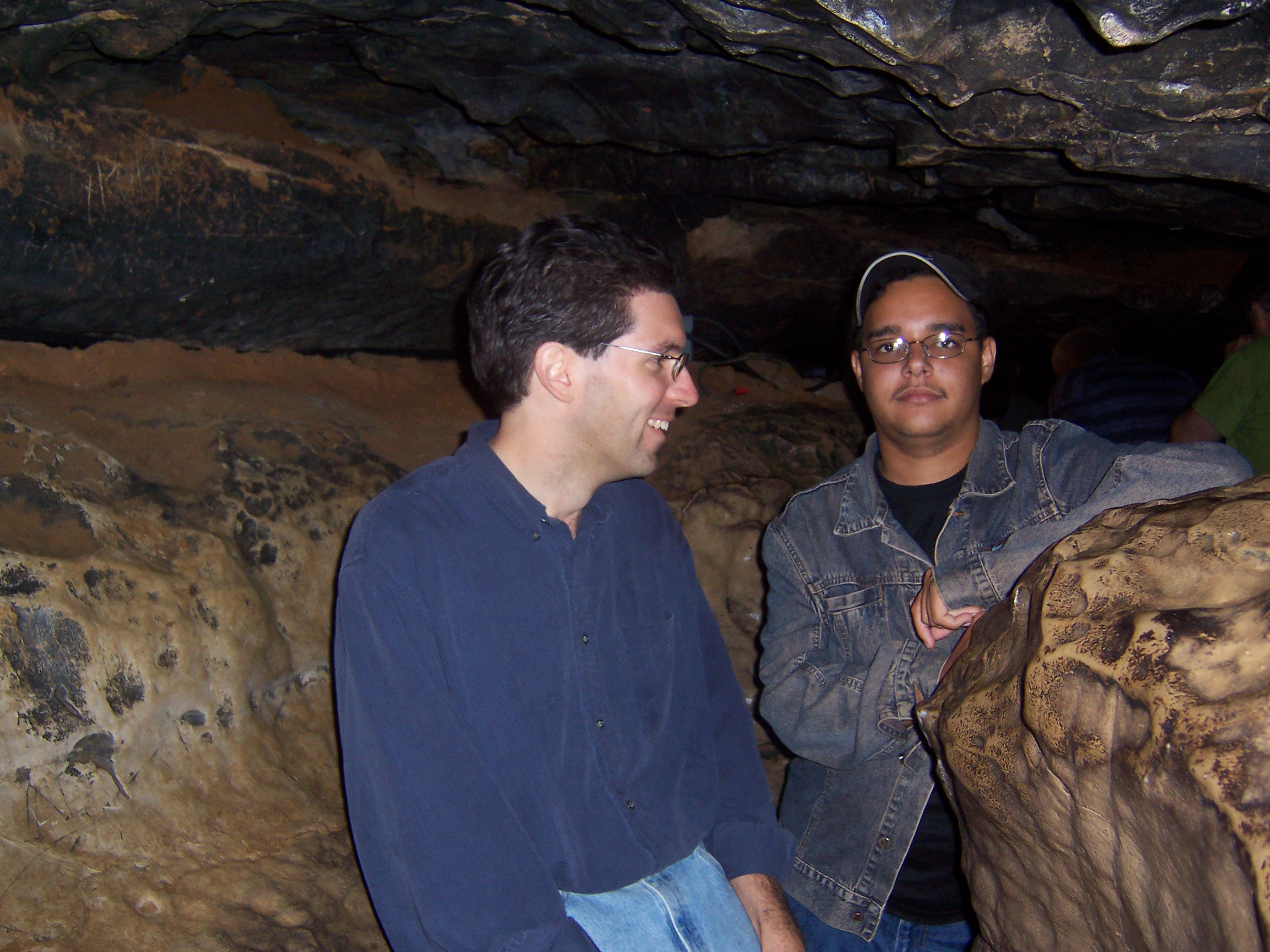 With an REU student inside Mammoth Caves.
Service to the Department
With an REU student inside Mammoth Caves.
Service to the Department
Department-level service is where every faculty member starts and where most of the daily operational work lives. Every department needs faculty who will serve on admissions committees, review curriculum proposals, participate in hiring, mentor students, and take on the administrative roles that keep the graduate and undergraduate programs running. What catches people off guard is that some departmental roles are dramatically larger than others, and the DGS position in particular is essentially a part-time administrative job layered on top of a full faculty load. My most significant departmental service has been serving as Director of Graduate Studies for the ECE Department from November 2020 through the present. This role is the single largest service commitment in the department, encompassing graduate admissions, advisory committee oversight, qualifying exam administration, doctoral defense coordination, graduation certification, TA and RA management, tuition scholarship allocation, immigration compliance for international students, and liaison responsibilities with both the College of Engineering and the Graduate School. The position is governed by overlapping layers of regulation—the AR: Academic and Student Affairs (PDF), the DGS Manual (PDF), and federal immigration law—and involves daily operational decisions that directly affect student funding, enrollment, and degree progress. A detailed account of the role is available on my DGS pages. Beyond the formal DGS role, direct mentoring of graduate students is the most important service a faculty member provides at the department level—and it is the one that tenure and promotion committees weight most heavily after research and teaching records. I have advised multiple PhD students to completion: Wei Su defended “Axial Motion Stereo Vision and Structured Light Illumination for 3-Dimensional Acquisition of the Human Ear” in 2006; Jan Bacca Rodriguez completed “Blue-Noise Digital Multitoning” at the University of Delaware in 2007; and Yongchang Wang finished “Novel Approaches in Structured Light Illumination” in 2010. Each of these dissertations grew directly from my research program in structured light and digital halftoning, which is exactly how mentoring should work—the advising deepens one’s own scholarship while training the next generation.
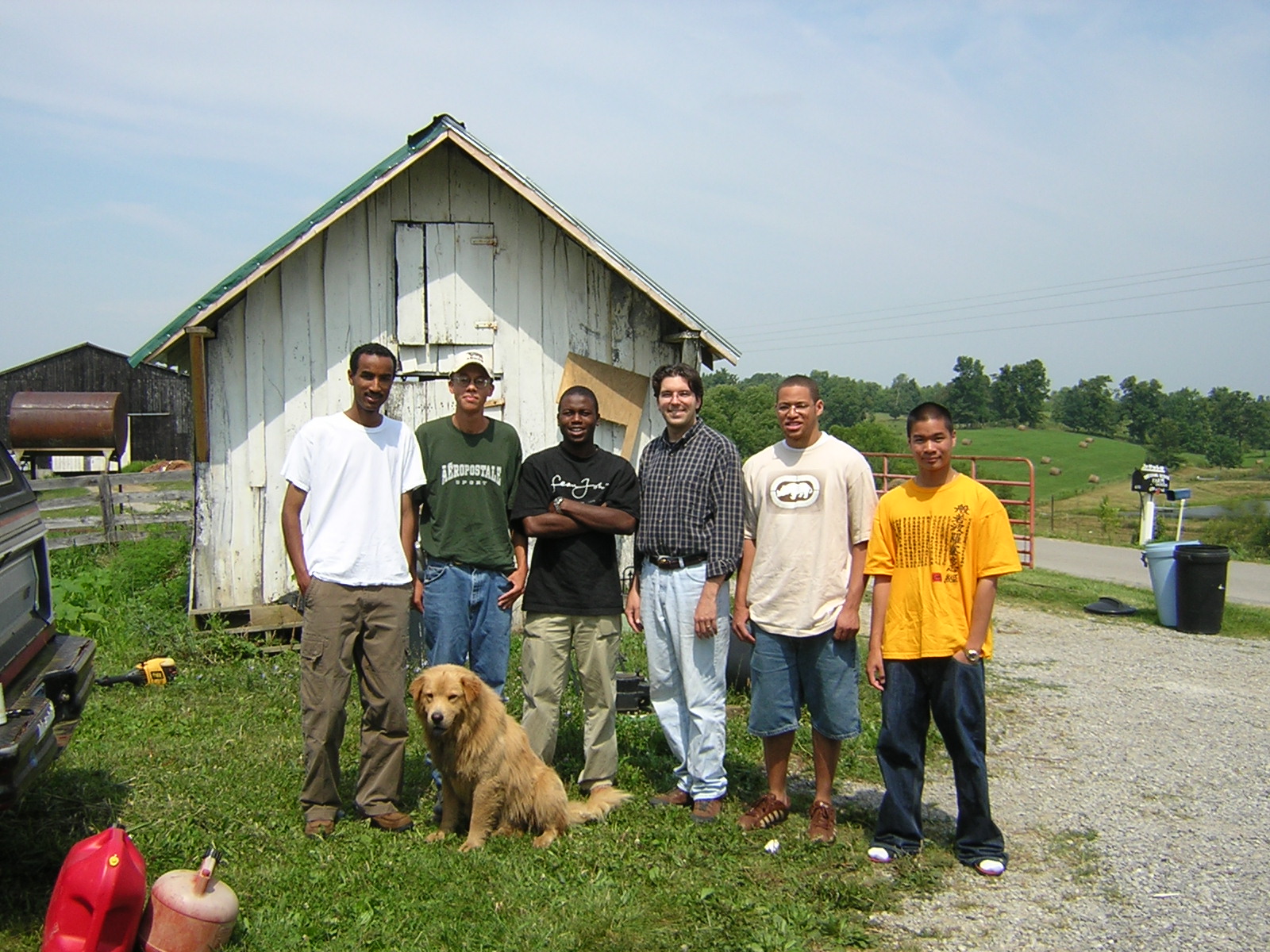 With students from the Freshman Summer Program Research Experience.
I have also maintained an ongoing commitment to mentoring high school students through research project sponsorship, introducing them to engineering research before they arrive at the university. I also served as faculty mentor for the University’s Freshman Summer Program Research Experience, a six-week residential enrichment program designed to help incoming students build academic skills and establish research connections early. These pipeline activities are easy to overlook in a service statement, but they are how departments build their future applicant pools—and the students mentored at this stage remember their faculty sponsors for decades.
Service to the College and University
With students from the Freshman Summer Program Research Experience.
I have also maintained an ongoing commitment to mentoring high school students through research project sponsorship, introducing them to engineering research before they arrive at the university. I also served as faculty mentor for the University’s Freshman Summer Program Research Experience, a six-week residential enrichment program designed to help incoming students build academic skills and establish research connections early. These pipeline activities are easy to overlook in a service statement, but they are how departments build their future applicant pools—and the students mentored at this stage remember their faculty sponsors for decades.
Service to the College and University
University-level service is where impact extends beyond one’s own department, and it is also where a faculty member learns how the institution actually works. The committee structures, the governance pathways, the way resources get allocated—none of this is visible from inside a single department. I have found that serving at the university level develops institutional knowledge that makes a faculty member more effective in every other dimension of the career, because it reveals the context within which departmental decisions are made. From 2013 to 2015, I co-chaired the University-wide Learning Management System Review Committee, representing the College of Engineering in a comprehensive evaluation of the university’s educational technology infrastructure. This was one of those roles that sounds bureaucratic but turns out to be genuinely consequential—we were deciding the platform that every faculty member and student on campus would use daily, and I learned a great deal about how the university makes high-stakes technology decisions. The work involved conducting an institution-wide assessment of Blackboard’s effectiveness, coordinating campus-wide surveys and stakeholder consultations, organizing public town halls and formal presentations to the Faculty Senate, and developing strategic recommendations for a technology transition affecting tens of thousands of users. The timeline was compressed and the stakes were high, because the decision would lock the university into a platform for years. The experience taught me how large institutions make decisions—slowly, with many constituencies, and with consequences that outlast the committee’s tenure.
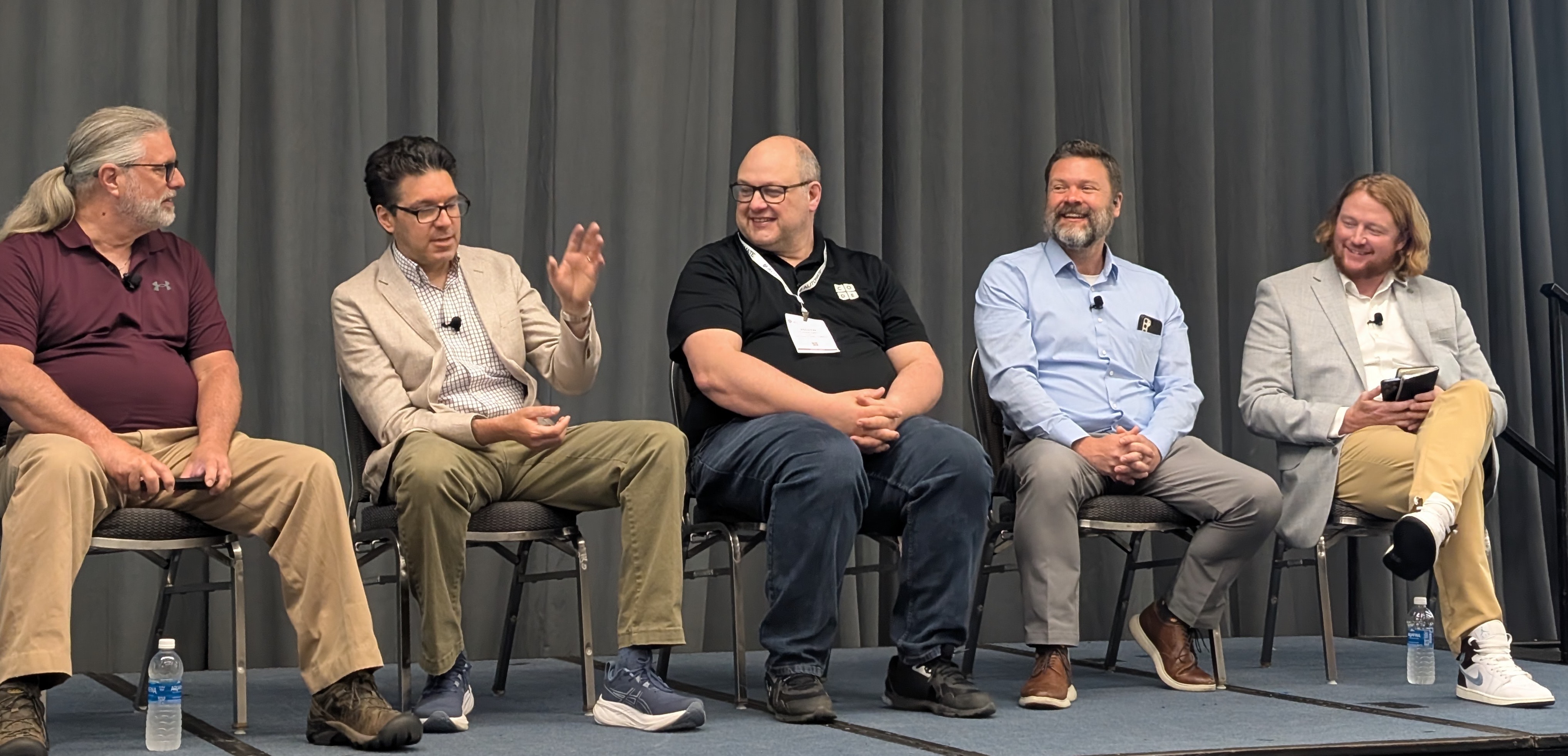 Presenting at Automate 2025 Educator Day in Detroit.
More recently, I participated in Automate 2025 Educator Day in Detroit, an A3 event that brought together educators, robotics mentors, and industry leaders to share best practices and hands-on approaches for integrating robotics, AI, and automation technologies into STEM and engineering curricula.
From 2004 to 2015, I served on the advisory board for the Office of Multicultural and Academic Affairs (now the Office for Institutional Diversity), appointed by Associate Provost Dr. Laurretta F. Byars. This service grew out of collaborative work on mentoring activities, and it focused on advancing retention strategies for underrepresented students in engineering, developing inclusive practices across the university, and facilitating resource allocation for student success programs. Eleven years on a single advisory board is unusual, but it reflects how deeply diversity and inclusion work is woven into the fabric of the institution—the problems evolve but they do not resolve, and continuity of perspective matters.
I also secured and managed NSF funding of $398,903 from 2006 to 2009 for a Research Experience for Undergraduates Site in Electrical and Computer Engineering. An REU site is part research infrastructure and part service—it provides transformative research opportunities for undergraduate students from across the country, many from institutions without significant research programs, and the organizational overhead of running the site (recruiting, housing, mentoring, reporting) is substantial. The payoff was real: several REU participants went on to graduate programs in engineering, and the site raised the department’s national visibility among prospective graduate students.
My service contributions at the university level have been recognized through multiple University of Kentucky Wethington Awards in 2006, 2007, 2008, 2009, 2010, and 2014. The Wethington Award acknowledges excellence across service, teaching, and research, and receiving it in six separate years reflects a sustained commitment to institutional citizenship. I mention this not to catalog awards but because it reflects something I believe strongly: sustained institutional citizenship builds the kind of reputation that opens doors to leadership opportunities later.
Service to the Profession and Society
Presenting at Automate 2025 Educator Day in Detroit.
More recently, I participated in Automate 2025 Educator Day in Detroit, an A3 event that brought together educators, robotics mentors, and industry leaders to share best practices and hands-on approaches for integrating robotics, AI, and automation technologies into STEM and engineering curricula.
From 2004 to 2015, I served on the advisory board for the Office of Multicultural and Academic Affairs (now the Office for Institutional Diversity), appointed by Associate Provost Dr. Laurretta F. Byars. This service grew out of collaborative work on mentoring activities, and it focused on advancing retention strategies for underrepresented students in engineering, developing inclusive practices across the university, and facilitating resource allocation for student success programs. Eleven years on a single advisory board is unusual, but it reflects how deeply diversity and inclusion work is woven into the fabric of the institution—the problems evolve but they do not resolve, and continuity of perspective matters.
I also secured and managed NSF funding of $398,903 from 2006 to 2009 for a Research Experience for Undergraduates Site in Electrical and Computer Engineering. An REU site is part research infrastructure and part service—it provides transformative research opportunities for undergraduate students from across the country, many from institutions without significant research programs, and the organizational overhead of running the site (recruiting, housing, mentoring, reporting) is substantial. The payoff was real: several REU participants went on to graduate programs in engineering, and the site raised the department’s national visibility among prospective graduate students.
My service contributions at the university level have been recognized through multiple University of Kentucky Wethington Awards in 2006, 2007, 2008, 2009, 2010, and 2014. The Wethington Award acknowledges excellence across service, teaching, and research, and receiving it in six separate years reflects a sustained commitment to institutional citizenship. I mention this not to catalog awards but because it reflects something I believe strongly: sustained institutional citizenship builds the kind of reputation that opens doors to leadership opportunities later.
Service to the Profession and Society
Professional service—reviewing papers, organizing conferences, serving on editorial boards and industry panels—is what connects work at the university to the broader community of scholars and practitioners in the field. It is also the most visible form of service to external reviewers evaluating a promotion case, because it signals that one’s peers consider the faculty member a contributor to the field and not just a consumer of it. My own trajectory followed what I think is a natural progression: manuscript reviewing early on, which sharpened my writing and kept me current with the state of the art, then program committees and conference organization, and eventually industry advisory positions that carry strategic influence.
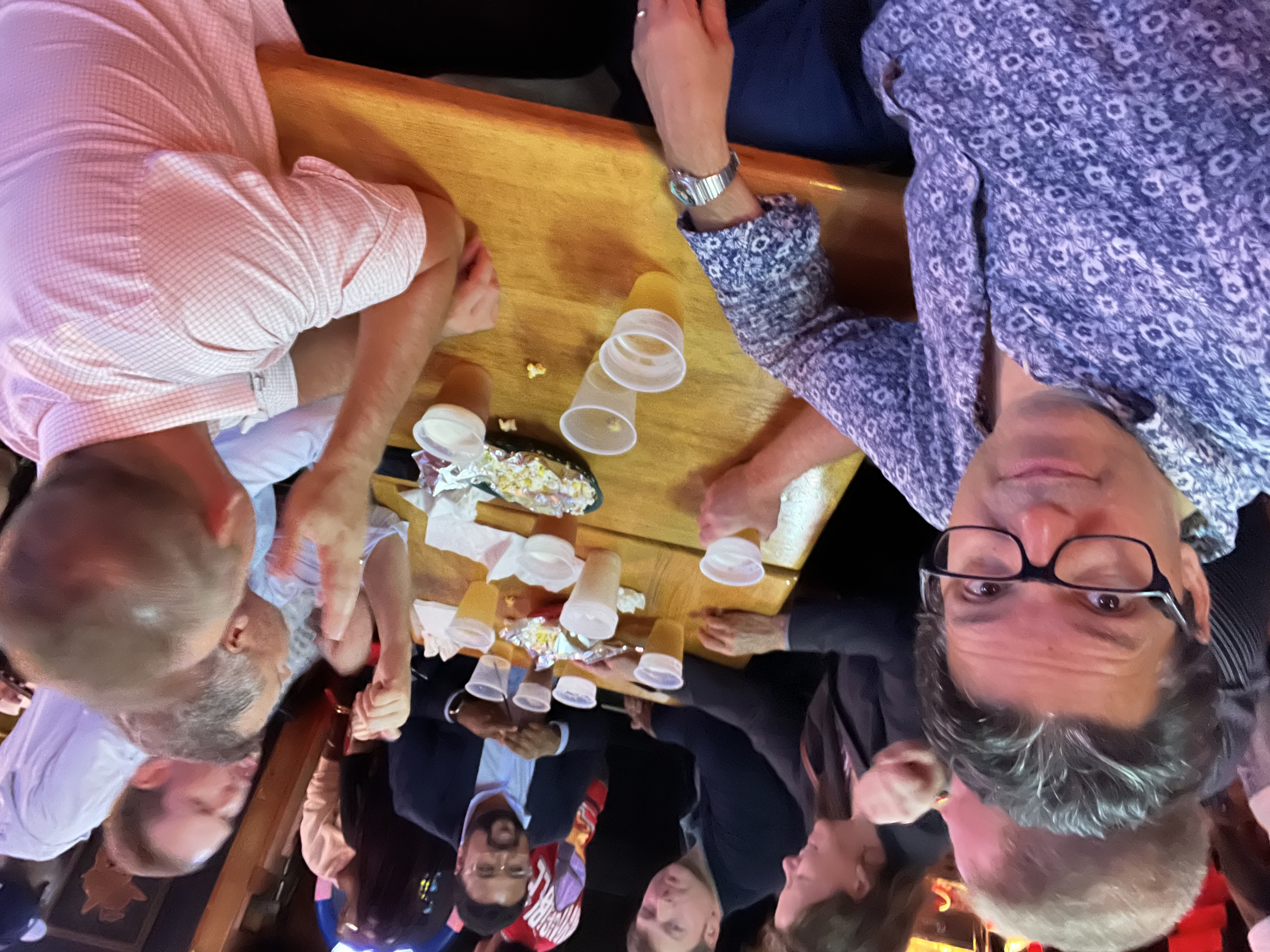 With fellow leaders on the A3 Imaging and Vision Board at the A3 Business Forum.
My most significant professional service appointment has been my election to the Vision Technology Strategy Board for the Association for Advancing Automation (A3), North America’s largest automation trade association representing over 1,300 organizations. This places me among seven industry leaders providing strategic direction for the machine vision and imaging industry—guiding policy development and advocacy for the $2+ billion machine vision market alongside representatives from 3M, SICK, Midwest Optical Systems, Pleora Technologies, and The Imaging Source. A3 serves as the umbrella organization for robotics, artificial intelligence, machine vision, and motion control, and the board shapes the future of these technologies across industries. This is the kind of service role that does not exist early in a career—it came from decades of published work, industry engagement, and a reputation built through the less glamorous service activities described below.
Since 2009, I have maintained an ongoing series of educational webinars for Vision Systems Design, a premier machine vision trade publication. These presentations—including “How to Develop Embedded Vision Applications with Off-the-Shelf Components” (June 2017), “Current and Future 3D Imaging Applications and Methods” (November 2016), and “Understanding Applications and Methods of 3D Imaging” (October 2015)—consistently attract over 700 registrants with 70–100 live participants per session. The six-month rebroadcast window extends the reach globally. I receive no compensation for these presentations, but they have been one of the most effective professional investments I have made: each webinar reaches practicing engineers who may never attend an academic conference, and the cumulative visibility contributed directly to my selection for the A3 board. This is an example of how service and research reputation compound over time—each webinar reinforced my standing in the machine vision community, and that standing eventually opened a door to strategic industry leadership.
I served three consecutive years (2005–2007) on the Program Committee for Space Technologies and Operations, Spaceborne Sensors at the SPIE Defense and Security Symposium, reviewing submissions and shaping the technical program in defense-related imaging and sensing. In 2001, I served as Publications Co-Chair for the IEEE-EURASIP Workshop on Nonlinear Signal and Image Processing while also chairing the Digital Halftoning session. Conference organization is unglamorous but essential service: someone has to solicit papers, coordinate reviews, and build a coherent program, and I found that the willingness to do it reliably is what led to invitations for larger roles.
Throughout my career, I have served as a regular reviewer for IEEE Transactions on Image Processing, Journal of the Optical Society of America A, SPIE Electronic Imaging, and SIGGRAPH, along with multiple other IEEE and Optica publications. Reviewing is the baseline professional service obligation—if one publishes in a journal, one should be willing to review for it—and it is also one of the best ways to stay current with emerging methods in the subfield. I have found that thorough, constructive reviews build a reputation with editors and lead to invitations for associate editor and program committee roles.
With fellow leaders on the A3 Imaging and Vision Board at the A3 Business Forum.
My most significant professional service appointment has been my election to the Vision Technology Strategy Board for the Association for Advancing Automation (A3), North America’s largest automation trade association representing over 1,300 organizations. This places me among seven industry leaders providing strategic direction for the machine vision and imaging industry—guiding policy development and advocacy for the $2+ billion machine vision market alongside representatives from 3M, SICK, Midwest Optical Systems, Pleora Technologies, and The Imaging Source. A3 serves as the umbrella organization for robotics, artificial intelligence, machine vision, and motion control, and the board shapes the future of these technologies across industries. This is the kind of service role that does not exist early in a career—it came from decades of published work, industry engagement, and a reputation built through the less glamorous service activities described below.
Since 2009, I have maintained an ongoing series of educational webinars for Vision Systems Design, a premier machine vision trade publication. These presentations—including “How to Develop Embedded Vision Applications with Off-the-Shelf Components” (June 2017), “Current and Future 3D Imaging Applications and Methods” (November 2016), and “Understanding Applications and Methods of 3D Imaging” (October 2015)—consistently attract over 700 registrants with 70–100 live participants per session. The six-month rebroadcast window extends the reach globally. I receive no compensation for these presentations, but they have been one of the most effective professional investments I have made: each webinar reaches practicing engineers who may never attend an academic conference, and the cumulative visibility contributed directly to my selection for the A3 board. This is an example of how service and research reputation compound over time—each webinar reinforced my standing in the machine vision community, and that standing eventually opened a door to strategic industry leadership.
I served three consecutive years (2005–2007) on the Program Committee for Space Technologies and Operations, Spaceborne Sensors at the SPIE Defense and Security Symposium, reviewing submissions and shaping the technical program in defense-related imaging and sensing. In 2001, I served as Publications Co-Chair for the IEEE-EURASIP Workshop on Nonlinear Signal and Image Processing while also chairing the Digital Halftoning session. Conference organization is unglamorous but essential service: someone has to solicit papers, coordinate reviews, and build a coherent program, and I found that the willingness to do it reliably is what led to invitations for larger roles.
Throughout my career, I have served as a regular reviewer for IEEE Transactions on Image Processing, Journal of the Optical Society of America A, SPIE Electronic Imaging, and SIGGRAPH, along with multiple other IEEE and Optica publications. Reviewing is the baseline professional service obligation—if one publishes in a journal, one should be willing to review for it—and it is also one of the best ways to stay current with emerging methods in the subfield. I have found that thorough, constructive reviews build a reputation with editors and lead to invitations for associate editor and program committee roles.
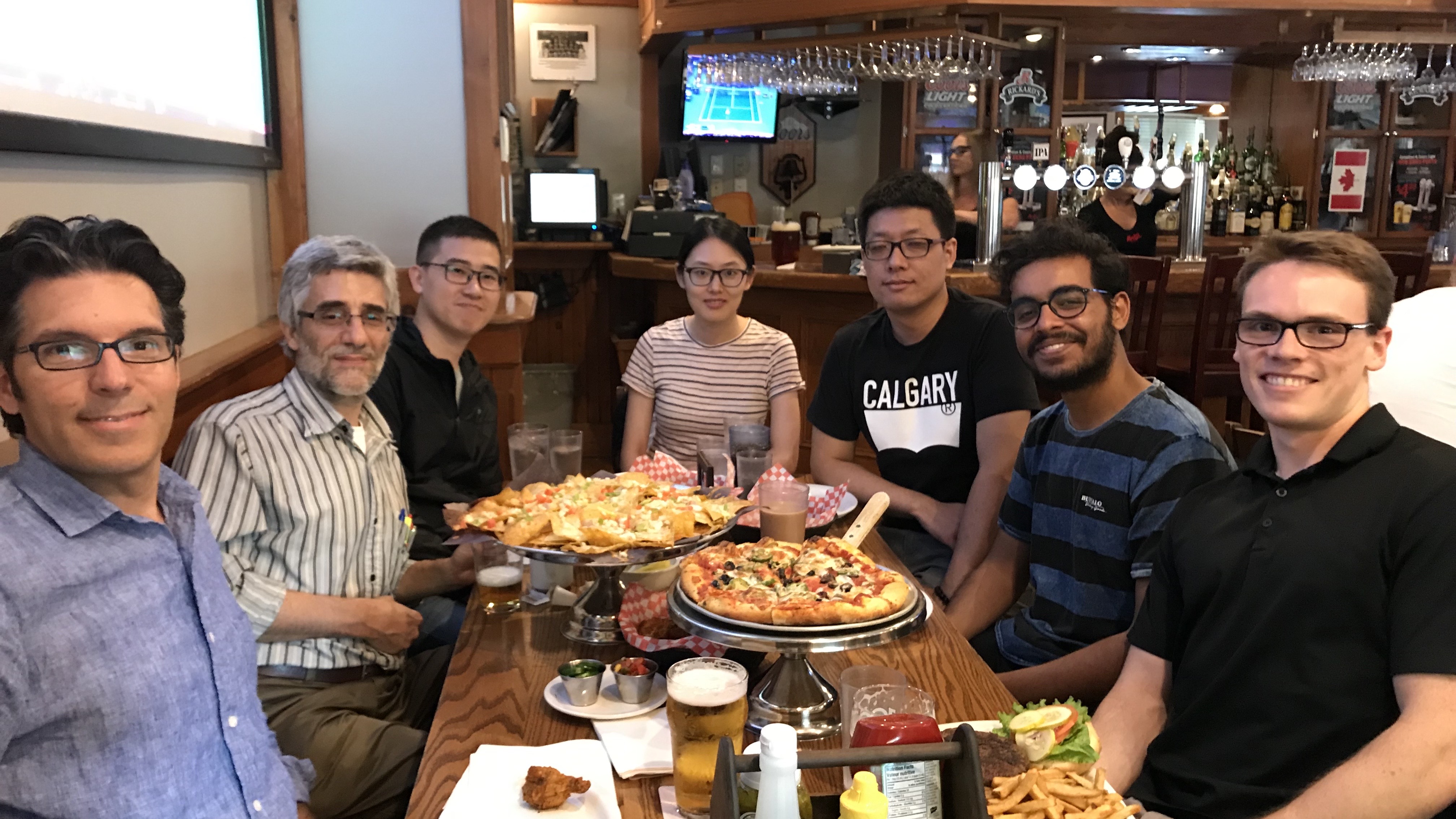 Visiting the University of Waterloo as an outside Ph.D. committee member for a dissertation on structured light.
I am an IEEE Fellow, the highest grade of IEEE membership. Each year, the number of new Fellows elevated is capped at 0.1% of the total voting membership, and the process requires nomination by existing Fellows followed by rigorous evaluation by the Fellow Committee on the basis of outstanding contributions to the advancement or application of engineering, science, and technology. My elevation was through the IEEE Signal Processing Society, one of the oldest and largest of IEEE’s nearly 40 technical societies with over 23,000 members worldwide—which makes it one of the most competitive societies through which to be nominated, given the depth of the candidate pool. The citation recognizes a body of work spanning digital printing and 3D imaging that has been sustained across more than two decades of publication, patenting, and technology transfer. I also maintain active Professional Engineer certification (since 2014). PE certification is less common among ECE faculty than in civil or mechanical engineering, but I have found it valuable given the extent to which my research intersects with industry standards and regulatory frameworks—and it carries weight in industry service roles like the A3 board.
Visiting the University of Waterloo as an outside Ph.D. committee member for a dissertation on structured light.
I am an IEEE Fellow, the highest grade of IEEE membership. Each year, the number of new Fellows elevated is capped at 0.1% of the total voting membership, and the process requires nomination by existing Fellows followed by rigorous evaluation by the Fellow Committee on the basis of outstanding contributions to the advancement or application of engineering, science, and technology. My elevation was through the IEEE Signal Processing Society, one of the oldest and largest of IEEE’s nearly 40 technical societies with over 23,000 members worldwide—which makes it one of the most competitive societies through which to be nominated, given the depth of the candidate pool. The citation recognizes a body of work spanning digital printing and 3D imaging that has been sustained across more than two decades of publication, patenting, and technology transfer. I also maintain active Professional Engineer certification (since 2014). PE certification is less common among ECE faculty than in civil or mechanical engineering, but I have found it valuable given the extent to which my research intersects with industry standards and regulatory frameworks—and it carries weight in industry service roles like the A3 board.
With an REU student inside Mammoth Caves.
Department-level service is where every faculty member starts and where most of the daily operational work lives. Every department needs faculty who will serve on admissions committees, review curriculum proposals, participate in hiring, mentor students, and take on the administrative roles that keep the graduate and undergraduate programs running. What catches people off guard is that some departmental roles are dramatically larger than others, and the DGS position in particular is essentially a part-time administrative job layered on top of a full faculty load. My most significant departmental service has been serving as Director of Graduate Studies for the ECE Department from November 2020 through the present. This role is the single largest service commitment in the department, encompassing graduate admissions, advisory committee oversight, qualifying exam administration, doctoral defense coordination, graduation certification, TA and RA management, tuition scholarship allocation, immigration compliance for international students, and liaison responsibilities with both the College of Engineering and the Graduate School. The position is governed by overlapping layers of regulation—the AR: Academic and Student Affairs (PDF), the DGS Manual (PDF), and federal immigration law—and involves daily operational decisions that directly affect student funding, enrollment, and degree progress. A detailed account of the role is available on my DGS pages. Beyond the formal DGS role, direct mentoring of graduate students is the most important service a faculty member provides at the department level—and it is the one that tenure and promotion committees weight most heavily after research and teaching records. I have advised multiple PhD students to completion: Wei Su defended “Axial Motion Stereo Vision and Structured Light Illumination for 3-Dimensional Acquisition of the Human Ear” in 2006; Jan Bacca Rodriguez completed “Blue-Noise Digital Multitoning” at the University of Delaware in 2007; and Yongchang Wang finished “Novel Approaches in Structured Light Illumination” in 2010. Each of these dissertations grew directly from my research program in structured light and digital halftoning, which is exactly how mentoring should work—the advising deepens one’s own scholarship while training the next generation.
With students from the Freshman Summer Program Research Experience.
University-level service is where impact extends beyond one’s own department, and it is also where a faculty member learns how the institution actually works. The committee structures, the governance pathways, the way resources get allocated—none of this is visible from inside a single department. I have found that serving at the university level develops institutional knowledge that makes a faculty member more effective in every other dimension of the career, because it reveals the context within which departmental decisions are made. From 2013 to 2015, I co-chaired the University-wide Learning Management System Review Committee, representing the College of Engineering in a comprehensive evaluation of the university’s educational technology infrastructure. This was one of those roles that sounds bureaucratic but turns out to be genuinely consequential—we were deciding the platform that every faculty member and student on campus would use daily, and I learned a great deal about how the university makes high-stakes technology decisions. The work involved conducting an institution-wide assessment of Blackboard’s effectiveness, coordinating campus-wide surveys and stakeholder consultations, organizing public town halls and formal presentations to the Faculty Senate, and developing strategic recommendations for a technology transition affecting tens of thousands of users. The timeline was compressed and the stakes were high, because the decision would lock the university into a platform for years. The experience taught me how large institutions make decisions—slowly, with many constituencies, and with consequences that outlast the committee’s tenure.
Presenting at Automate 2025 Educator Day in Detroit.
Professional service—reviewing papers, organizing conferences, serving on editorial boards and industry panels—is what connects work at the university to the broader community of scholars and practitioners in the field. It is also the most visible form of service to external reviewers evaluating a promotion case, because it signals that one’s peers consider the faculty member a contributor to the field and not just a consumer of it. My own trajectory followed what I think is a natural progression: manuscript reviewing early on, which sharpened my writing and kept me current with the state of the art, then program committees and conference organization, and eventually industry advisory positions that carry strategic influence.
With fellow leaders on the A3 Imaging and Vision Board at the A3 Business Forum.
Visiting the University of Waterloo as an outside Ph.D. committee member for a dissertation on structured light.
