The Director of Graduate Studies in ECE is, at its core, an operational role: the DGS manages the daily responsibilities required to recruit, support, and graduate the department's students as stipulated by the Graduate School. What makes it expansive is that "daily responsibilities" turns out to touch virtually everything—admissions, funding, immigration, committee formation, qualifying exams, defenses, course registration, tuition scholarships, TA credentialing, and graduation—all governed by overlapping layers of regulation that occasionally contradict each other.
Anyone stepping into this role will already know the university and the basic arc of a graduate student's career. What I did not fully appreciate until I was in the chair is how much of the DGS's time is spent not on policy but on exceptions, emergencies, and the gaps between what the regulations say and what actually happens. A student's committee gets rejected because a departed faculty member is still listed. An international student's visa interview falls two days after TA orientation. The Graduate School changes which courses count toward an AMP degree and announces it the week before registration opens. A TA refuses to accept his GSAS contract because it says "Teaching Assistant" when his offer letter says "Research Assistant"—and the acceptance deadline is tomorrow. These are not unusual days; they are the job.
Three layers of regulation frame everything. The AR: University Organization (PDF) defines the Graduate Faculty and grants the DGS authority to propose Graduate Faculty appointments. The AR: Academic and Student Affairs (PDF) establishes the specific rules for admission, coursework, examinations, time limits, and graduation. The Graduate School's DGS Manual (PDF) translates those regulations into operational procedures and adds policies on tuition scholarships, TA credentialing, and international student enrollment. Where the DGS Manual and the ARs disagree—and they do, on things like the probation credit-hour threshold and QE reporting deadlines—the ARs control. The DGS will also live with AR 5:2 (TA/RA appointments) and AR 5:3 (language screening) on a near-weekly basis.
The DGS works closely with the Academic Coordinator, who handles much of the day-to-day operational detail; the Department Chair, who makes budgetary decisions; the departmental business officer, for grant and payroll matters; and the College's Director of Research and Graduate Studies, for tuition scholarship coordination. Understanding who owns what saves time, but the boundaries blur constantly.
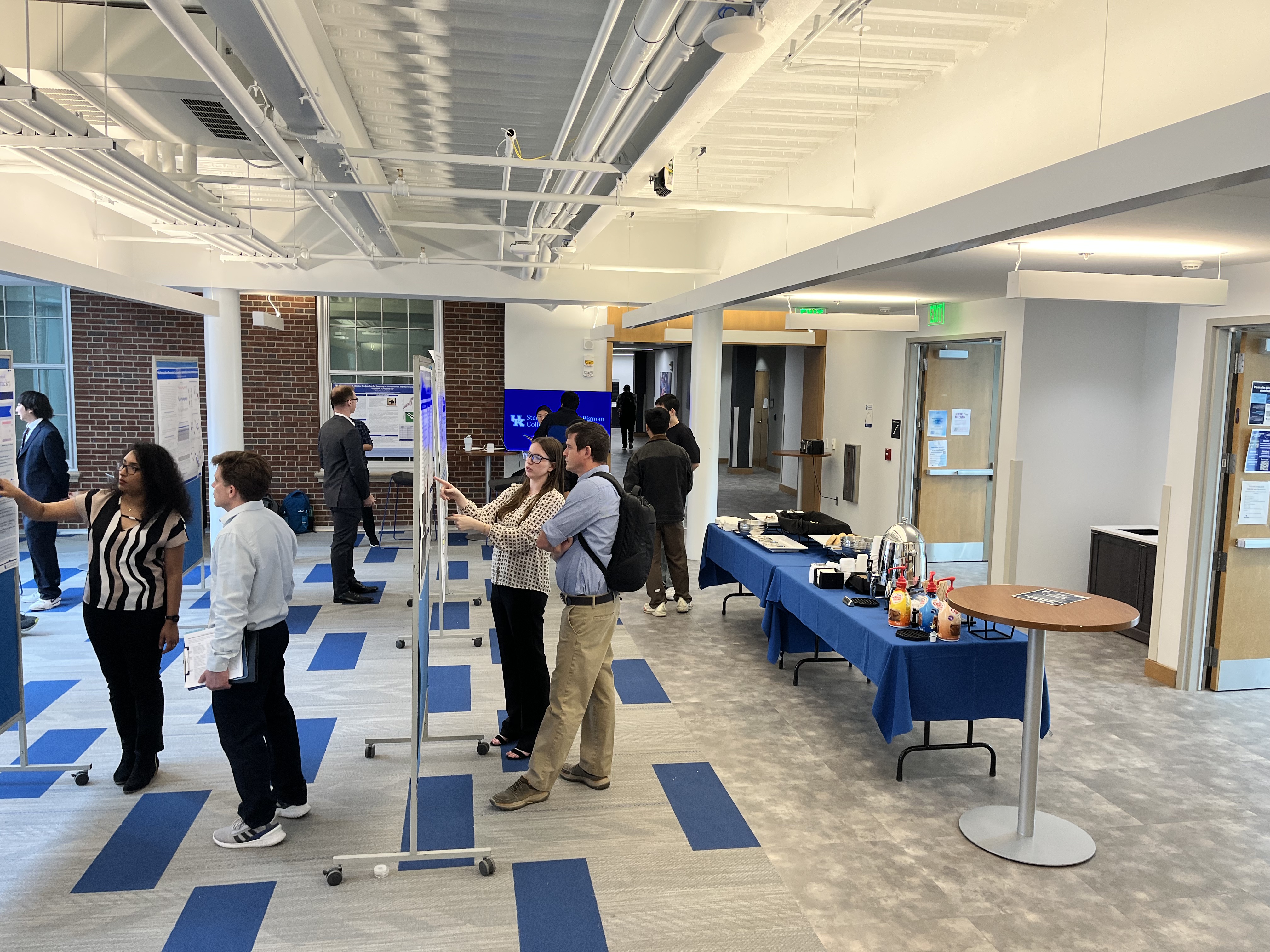 The ECE Spring Research Symposium, organized annually as part of DGS responsibilities.
The pages linked below organize the role into four functional areas plus a month-by-month annual cycle. They are written to convey the feel of the job—not just what the regulations say, but what the work actually looks like—based on experience spanning November 2020 through February 2026.
Academic Governance & Policy
The ECE Spring Research Symposium, organized annually as part of DGS responsibilities.
The pages linked below organize the role into four functional areas plus a month-by-month annual cycle. They are written to convey the feel of the job—not just what the regulations say, but what the work actually looks like—based on experience spanning November 2020 through February 2026.
Academic Governance & Policy
The DGS is the department's primary liaison to the College and the Graduate School, and the gatekeeper for every non-routine course action a graduate student takes. This means Graduate Council business, USP and AMP programs, add/drop processing, credit overloads, enrollment compliance, incomplete grades, scholastic probation, and keeping the graduate handbook current. The USP/AMP area is deceptively complex—student classification, double-counting limits, and cross-departmental petitions generate a surprising amount of back-and-forth with the Graduate School. Read more » Student Milestones & Examinations
From the moment a student forms a committee through qualifying exams, the doctoral defense, and graduation, the DGS is the checkpoint. Committee composition errors are the single most common rejection, and one becomes intimately familiar with what "at least one from outside the program" actually means. The written qualifying exam is entirely the DGS's operation—soliciting questions, setting logistics, proctoring, and managing the consequences when students fail. Defenses require careful paperwork choreography, and graduation is a relentless cycle of deadline tracking and credit-hour verification. Read more »
 Another photo of the ECE Spring Research Symposium.
Funding & Appointments
Another photo of the ECE Spring Research Symposium.
Funding & Appointments
The DGS controls the department's DTS and ATS tuition scholarship budgets and coordinates virtually every aspect of TA and RA life—allocation, offer letters, GSAS processing, language screening, SACSCOC credentialing, and evaluations. The GSAS system alone consumes significant time each August and January, because every contract must be entered, accepted by the student, and verified before hard deadlines—and unaccepted funds still count against the department's allocation. The role entails DTS reconciliation spreadsheets, TA credential audits with ten-day deadlines, and the occasional administrative error that cascades through payroll, benefits, and tuition simultaneously. Read more » Admissions & International Students
The DGS issues every departmental admissions recommendation and manages the full lifecycle of incoming students, including deferrals for those who cannot arrive on time. For international students—who make up the majority of the graduate population—the DGS is the academic authority that ISSS relies on for enrollment confirmations, CPT/OPT processing, I-20 documentation, and resolving visa complications that sometimes escalate to embassy-level emergencies. Immigration compliance is woven into nearly everything the DGS does, from course registration to funding letters to leave-of-absence requests. Read more » The Annual Cycle
All twelve responsibility areas interleave across the academic year in a pattern that is predictable but relentless. August and January are the most intense months—TA allocations, GSAS processing, DTS submissions, and international student enrollment all converge in narrow windows where a single day's delay can cost an advisor thousands of dollars. April is the peak for committee activity. The annual cycle page walks through the year month by month to show exactly when everything hits. Read more »
The ECE Spring Research Symposium, organized annually as part of DGS responsibilities.
The DGS is the department's primary liaison to the College and the Graduate School, and the gatekeeper for every non-routine course action a graduate student takes. This means Graduate Council business, USP and AMP programs, add/drop processing, credit overloads, enrollment compliance, incomplete grades, scholastic probation, and keeping the graduate handbook current. The USP/AMP area is deceptively complex—student classification, double-counting limits, and cross-departmental petitions generate a surprising amount of back-and-forth with the Graduate School. Read more » Student Milestones & Examinations
From the moment a student forms a committee through qualifying exams, the doctoral defense, and graduation, the DGS is the checkpoint. Committee composition errors are the single most common rejection, and one becomes intimately familiar with what "at least one from outside the program" actually means. The written qualifying exam is entirely the DGS's operation—soliciting questions, setting logistics, proctoring, and managing the consequences when students fail. Defenses require careful paperwork choreography, and graduation is a relentless cycle of deadline tracking and credit-hour verification. Read more »
Another photo of the ECE Spring Research Symposium.
The DGS controls the department's DTS and ATS tuition scholarship budgets and coordinates virtually every aspect of TA and RA life—allocation, offer letters, GSAS processing, language screening, SACSCOC credentialing, and evaluations. The GSAS system alone consumes significant time each August and January, because every contract must be entered, accepted by the student, and verified before hard deadlines—and unaccepted funds still count against the department's allocation. The role entails DTS reconciliation spreadsheets, TA credential audits with ten-day deadlines, and the occasional administrative error that cascades through payroll, benefits, and tuition simultaneously. Read more » Admissions & International Students
The DGS issues every departmental admissions recommendation and manages the full lifecycle of incoming students, including deferrals for those who cannot arrive on time. For international students—who make up the majority of the graduate population—the DGS is the academic authority that ISSS relies on for enrollment confirmations, CPT/OPT processing, I-20 documentation, and resolving visa complications that sometimes escalate to embassy-level emergencies. Immigration compliance is woven into nearly everything the DGS does, from course registration to funding letters to leave-of-absence requests. Read more » The Annual Cycle
All twelve responsibility areas interleave across the academic year in a pattern that is predictable but relentless. August and January are the most intense months—TA allocations, GSAS processing, DTS submissions, and international student enrollment all converge in narrow windows where a single day's delay can cost an advisor thousands of dollars. April is the peak for committee activity. The annual cycle page walks through the year month by month to show exactly when everything hits. Read more »
